
This post's average rating is: 5
It had been five years since we came to the village of Nagothane, nestled deep in the lush Konkan region of Maharashtra state, a place that had, over time, grown into a willing home. My father worked in the Forest Department as a Divisional Forest Officer, and his profession meant that our family lived like wandering birds. Every three or four years, just as friendships began to carve themselves into permanence, we were uprooted again. A new town, new neighbours, a new school, new friends, and an ache of old memories that refused to fade.
For us siblings, the cycle was exhausting, planting fresh seeds of friendship while the roots of the old ones still tugged painfully at the heart. After every transfer, for a few days at least, letters would be exchanged with our former friends. Updates about our new school, new surroundings, new faces, each chapter faithfully posted to the old world we had left behind. Slowly, new friendships would form, and life would once again begin to flow smoothly.
At that time, I was in my first year of college. My two elder sisters were in Mumbai, pursuing nursing, one at Jaslok Hospital, the other at J. J. Hospital, living in their respective hostels. At home, it was just my mother, my younger sister, and me. That year, once again, my father was transferred, this time to Khopoli. Tired of the constant displacements, we siblings protested fiercely: “New school, new college, new friends again? We can’t do this anymore!”
Our father understood the depth of our struggle. He decided to shift alone to Khopoli, working there during the week and returning home every Saturday and Sunday. It was a decision that forever softened our hearts towards him.
By sheer fortune, all of us found wonderful friends in Nagothane, friendships that have survived to this very day. Every evening after school, we wandered through the village. It was a small settlement, spread along community-based clusters like Brahmin Ali, Angar Ali, Kumbhar Ali, and Gurav Ali. A Muslim mohalla stood near the market.
Beyond the village flowed the Amba River, over which stood a narrow bridge built in 1580 during the Nizamshahi era. Constructed from lime and stone, it was barely wide enough for a single vehicle at a time. This bridge was our favourite haunt. We friends would sit on its parapet every evening, legs dangling, chatting about everything and nothing. Whenever a vehicle approached, we would quickly pull our legs up onto the parapet, our hearts racing with that tempting brush of danger, vehicle on one side, the roaring river on the other, and nothing to hold onto except the thrill of being young and foolish. Miraculously, none of us ever fell.
The Amba’s riverbed was rugged, its moods unpredictable. Every monsoon brought floods, sometimes mild, sometimes menacing. The waters would spill up to the S.T. bus stand outside the village, sometimes sweeping into the fishermen’s hamlet as well. Property damage was common, but never had there been a loss of life. Perhaps that was why villagers treated floods like a seasonal spectacle. They would step out in the pouring rain just to “watch the flood,” arguing animatedly about how high the water had risen compared to previous years.
Sunday was weekly market day. The entire region converged at Nagothane’s bustling bazaar. People bought in bulk during the monsoons, and shopkeepers stocked up days in advance. But on Saturday, 22 July 1989, the monsoon seemed determined to script a story that would scare Konkan for generations. Rain began intensifying in the evening, pounding steadily through the night. Shopkeepers, unaware of the catastrophe brewing, slept peacefully after securing their goods.
But somewhere past midnight, the heavens tore open. Lightning cracked the sky, winds roared like possessed spirits, and rain crashed over the entire Konkan plateau. Raigad, Ratnagiri, and the surrounding belt came under the fury of nature no one had witnessed in decades.
No one, except the night guards, Gurkhas appointed by the Gram Panchayat was awake to witness nature’s wrath. Their frantic whistles and shouts eventually woke a few villagers. The Amba River had swollen beyond its limits. Water had crossed the boundary of the bus stand and now, for the first time in years, had begun pouring into the village itself.
Panic spread like wildfire.
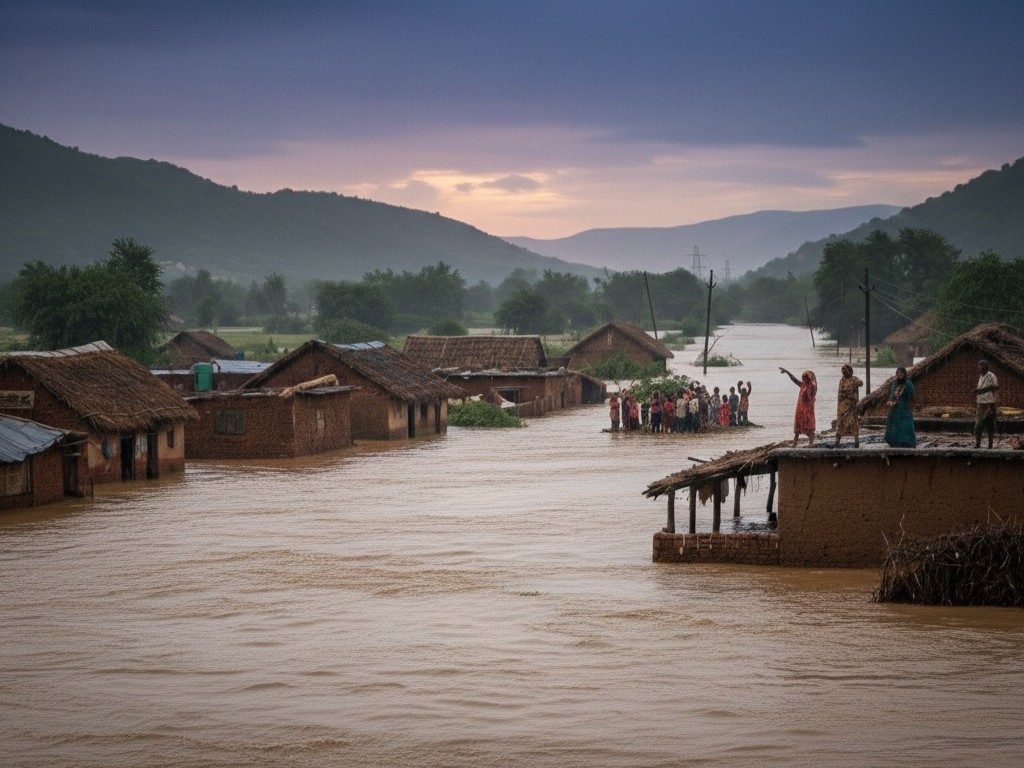
People banged on neighbours’ doors, scrambling to shift belongings to safer places. But the floodwater moved faster, much faster than human fear. Within minutes, the market and the adjoining settlements were swallowed whole. Those who could run, ran eastward towards higher ground. Others took shelter on lofts and rooftops, praying the water would not rise further.
By dawn, Nagothane was unrecognizable, half-drowned under a brown, raging sea.
Around seven-thirty that morning, someone knocked at our door. My father opened it to find a family, five or six people, soaked from head to toe, shivering, exhausted, terrified.
“Sahib… our house has gone under water,” the eldest son said, his voice trembling. “Can we stay here for a few days?”
“Of course,” my father replied. “Looks like the rains were terrible last night.”
We lived in the upper part of the village, which the floodwater had spared by barely five hundred meters. We had slept through the chaos, unaware of the devastation around us.
In fact, we did not get any government bungalow or quarters in that village, so we rented a house. It was a set-up of two rooms, ten by sixteen feet, and a kitchen.
Our own rented house was small, two rooms of ten-by-sixteen feet, plus a kitchen. Yet now, suddenly, it had become a refuge for six more souls.
My mother welcomed them inside, offering dry clothes and preparing hot tea. But the eldest son, who had become the head of his family after his father’s passing, looked deeply distressed.
“Sahib… my younger sister, she is still trapped in our house on the upper loft with her baby.”
Hearing this, my father and we were all stunned.
Amazing work Dhananjay…. Keep it up!
The suspense just keeps getting better. The way you narrated the experience is absolutely incredible.
Very good
amazing