
We moved to Khopoli which is an important town located on the Mumbai–Pune highway. It is an industrially developed city with large factories, colleges, an engineering college, and a polytechnic institute. The town lies at the beginning of the Bor Ghat, or Khandala Ghat, which connects the two metropolitan cities of Mumbai and Pune, and at the foothills of the Sahyadri mountain ranges.
At that time, it was the only town in Maharashtra whose municipal council operated its own city bus transport system. Due to industrialization, the city experienced a very high level of pollution. Having migrated from Nagothane, a village blessed with natural beauty and free from pollution, it took us a long time to adjust to life in that city.
Meanwhile, I went to seek admission to a senior college. My mind was filled with dreams, the hope of a fresh beginning, and optimism about the future. However, since the academic year was already halfway through, I was denied admission. At that moment, it felt as if the ground beneath my feet had slipped away. I had no idea what to do next. The fear that I might lose an entire year began to take hold of my mind. That fear was not merely imaginary; there was a reason behind it.
Flashback…
During my school and college days, cricket was my true passion. When I was in the ninth grade, I became the youngest player to play for the “Jolly Cricket Club,” a group of senior players from Nagothane village. In district-level tournaments, I used to bat as the opening batsman.
But I was not only good at sports; I also performed exceptionally well academically. I passed my tenth grade with first class and stood second overall. In the preliminary examination, I scored ninety out of one hundred in English—a record that remained unbroken for many years. I had also won the “Ideal Student” award at school for two consecutive years. This award was given to the students who excelled in academics, sports, and extracurricular activities.
For my eleventh and twelfth grades, I took admission in the Commerce stream at a college in Pen. To attend college, I traveled daily by State Transport bus from Nagothane to Pen. The distance was about seventy kilometers, and it took nearly an hour and a half to reach Pen.
During my eleventh and twelfth years, I began to shine in cricket. Naturally, my attention toward studies started to decline. Traveling across the district to play matches, the company of friends, and the appreciation I received, amid all this, my studies slowly began to fall behind. My father used to be away from home for work five days a week, and that gave me even more freedom.
In the twelfth grade, only nine students from the entire class passed. Fortunately, I was one of those nine. However, deep down, I knew that the result was not worthy of my true potential.
I wanted to graduate and become a Police Sub-Inspector (PSI). To move in that direction, the Arts stream seemed more suitable to me. But in those days, Arts was widely considered a “time-pass” course that did not lead to good job opportunities. Because of that mindset, I had to take admission in the Commerce stream against my wishes. Subjects like Accounts and Bookkeeping felt very difficult to me. My mind never truly found interest in that world of numbers.
Once a very bright student, I had begun to drift away from academics due to my obsession with cricket. The same student who had earned recognition as the “Ideal Student” for two consecutive years now seemed to be stumbling badly in the field of education.
After passing the twelfth standard, I joined the first year of Commerce. Progress remained slow. Cricket never let me go. I skipped classes for tournaments. Even after scraping through my first year, there was no improvement. Anna’s hope for me had waned.
During this period, Anna noticed a newspaper advertisement for a course titled “Milk Production Management” at Dapchari. Admission was open to twelfth-pass students. Believing Commerce held no future for me, he persuaded me to apply.
In that moment, my PSI dream crumbled. Life felt as if my heart and circumstances were pulling me in opposite directions.
“This course will at least get him a government job in a dairy,” Anna said.
Aai laughed incredulously. “Do you need a course to take care of cows and buffaloes? Anyone can do that! What kind of course is this? Look for something else for him.”
Anna countered firmly, “You have seen his achievements so far. This is the only option available right now.”
Aai relented. “Fine… Do whatever you think is right.”
I applied and waited for the call letter. My dream of wearing a khaki uniform had faded into thin air. I started imagining myself in a cowshed, milking buffaloes, as my sisters teased me with shouts of “Ye dudhwala ..ye dudhwala…!”. The sting of my failure lingered in their laughter.
Anna had told my friends,
“Now Bandya will go for this Milk Management course.”
Madhu, whose uncle owned fifty or sixty cows and buffaloes, laughed and said,
“Anna, we have so many cattle at home. I never took any course, yet I earn money!”
Anna replied, “This course will teach him everything about the dairy business. He will get a well-paid supervisory job in a government or private dairy. This is his path now.”
Madhu forced a smile. He understood there was no point arguing with Anna.
Madhu had left school after the tenth standard and was looking after his uncle’s buffaloes. He used to come with me for running every morning at four o’clock. Obsessed with becoming a PSI, I used to wake up at four o’clock every morning and go for a run. It was dark outside at that hour, and Madhu would accompany me. He used to sleep outside in the shade near his house. When I woke him up so early in the morning, he would get very upset; yet he never said “no.” He always came with me.
Anna’s concern was evident. As a Class-One officer, he often reminded me,
“Don’t just aim for PSI. Prepare for IAS or IPS. Become a Class-One officer.”
He had even bought me the Manorama General Knowledge Yearbook, but cricket kept me away from even touching it.
Now even the dream of becoming a PSI seemed distant, and graduation felt impossible. Completing the Milk Management course and securing a dairy job seemed the only option. I was responsible for my own drift.
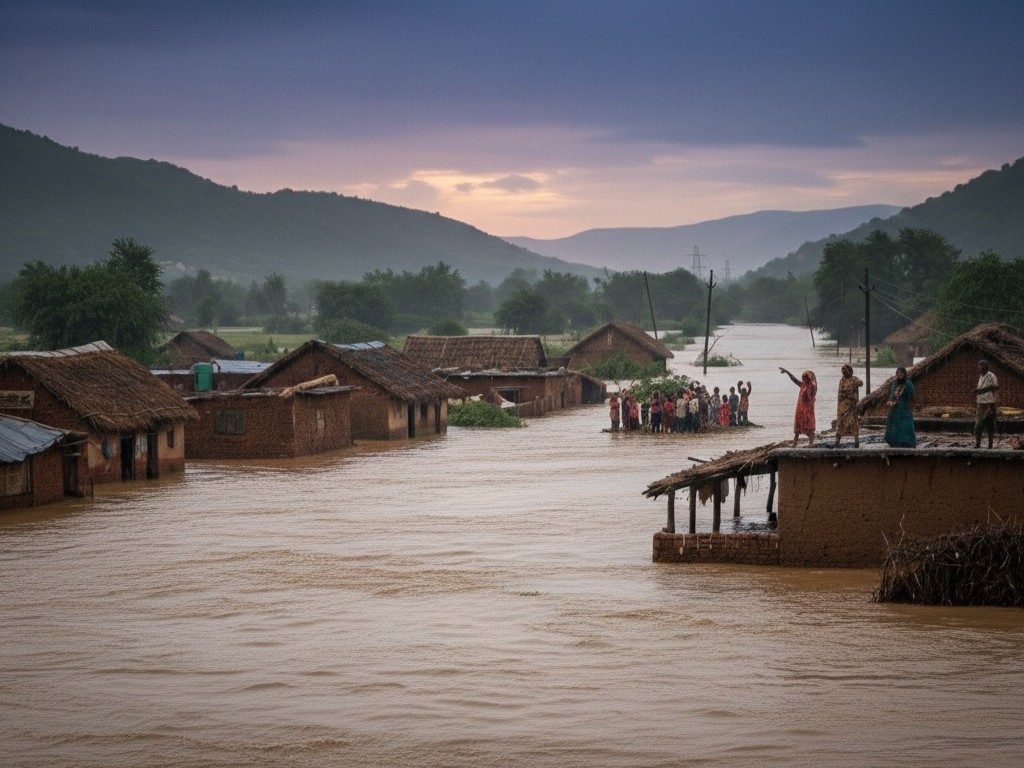
The flood struck at a time when I was already struggling with uncertainty about my future. In the chaos that followed, I secretly hoped Anna might forget about the dairy course he had forced me to apply for. But that hope proved to be nothing more than wishful thinking.
Meanwhile, the family that had taken shelter in our house eventually returned to their village. Soon after, we too began preparing to leave Nagothane and move to Khopoli.
One day, while we were discussing our departure, Anna called me aside.
“Look,” he said firmly, “everything has come to a standstill because of the flood. There’s no guarantee your call letter will reach us by post. Tomorrow, you go to Palghar. Take someone from there to Dapchari and find out what happened with your call letter. Ask them to send it to the Palghar address. Stay there until you receive it. Don’t come to Khopoli with us.”
I was barely eighteen or nineteen then. His words left me speechless. I had neither the courage to argue nor the opportunity to protest.
The floodwater had not yet receded; the entire region had remained paralyzed. Transportation was almost nonexistent, and yet I was expected to set out alone for Palghar.
Aai tried hard to convince Anna.
“Listen, in such a situation where will the boy go? Let the transport resume, then he can go.”
But Anna was not in a mood to listen.
That night Aai packed my bag. It was hardly a bag; it was a huge metal trunk. Inside it she placed two bed sheets, a blanket, and two or three sets of my clothes.
With tears in my eyes, I stepped out of the house early the next morning. Everyone in the family stood silently behind me to bid farewell. No one was saying anything. It felt like a strange, quiet goodbye as if I might never return home again. I wanted to turn back and look, but I could not.
As I reached the bend of the lane near our house, I heard Aai’s faint voice behind me:
“Go safely…!”
Wiping my tears, I started walking down the road.
Because of the floodwater, the S.T. bus stand was badly damaged, and the bus service was suspended. To find some other vehicle, I had to go to the highway. The trunk was far too big and heavy for someone my age. Carrying it alternately in both hands, I finally reached the highway after about fifteen or twenty minutes, already exhausted.
I wondered how I would reach Palghar with such a huge trunk. I stood by the roadside, hoping to find some vehicle. A few other people were also waiting there to travel to their villages.
Just then, a truck arrived. It was heading toward Khopoli. The driver leaned out of the window and asked,
“Where do you want to go?”
“Will you drop me at Pen?” I asked.
“Come on, get in!”
As soon as he said that two or three of us climbed in. The truck started moving. I sat near the cleaner on a wooden plank by the door.
Nagothane village was slowly fading behind us. Everywhere there was mud, debris carried by floodwater, and uprooted trees. The air was filled with a damp, rotten smell. The village no longer seemed fit for living.
I kept worrying about how I would reach Palghar. I had never traveled alone before. I felt like turning back, but now there was no choice.
The driver dropped me at the Pen junction and drove off toward Khopoli. Carrying that enormous trunk, I once again stood by the roadside. Traffic here was somewhat normal. After a while, a bus going to Mumbai arrived. I bought a ticket and took a seat. During the journey, I asked the S.T. conductor how to reach Palghar.
I left the house at seven in the morning after having tea and biscuits. It was already around twelve or twelve-thirty in the afternoon. Aai had packed vegetable curry and chapatis for me. Sitting on the bus, I opened the lunch box and ate. With every morsel, memories of home flooded my mind, and my eyes filled with tears.
By the time I got off at Mumbai Central station, the afternoon was almost over. From there I caught a train to Palghar. Carrying that huge trunk onto the train was extremely difficult. Because it was larger than usual, everyone looked at me curiously. After about one and a half to two hours of travel, I finally reached Palghar around six-thirty or seven in the evening.
From there I hired a horse cart and went to my grandparents’ house. Hearing the cart, my grandmother came outside. The moment she saw me arriving alone with that huge trunk, she began to cry loudly. She thought that everyone in my family had been swept away in the flood and that I was the only one who had survived. Calling out loudly, she shouted for my grandfather,
“Oh God… come out quickly! Look at him, he has come all alone. God knows what has happened…?”
News of the Nagothane flood had already appeared in newspapers, so my grandparents knew about the disaster. However, since all communication had been cut off, they had no idea about our situation. They only knew that we had been transferred earlier to that flood-ravaged village. Seeing me arriving suddenly with a trunk frightened her.
Grandfather also came out anxiously and asked,
“What happened? Where is everyone?”
“don’t worry, let me explain… everyone is fine,” I said.
Only then did they calm down a little. After going inside, I explained the entire situation and the purpose of my visit. Finally, my grandmother felt relieved. She agreed to accompany me to Dapchari the next day.
The next morning, my grandmother and I went to Dapchari. Near Talasari on the Mumbai–Ahmedabad National Highway, there was a huge government dairy at Dapchari. The Government of Maharashtra had started a “Milk Production Management Training Centre” there. The dairy was located amidst dense greenery. It had modern laboratories, research facilities, hostels for students, training centers, residential quarters for staff, and playground.
Hundreds of indigenous and foreign breeds of cows and buffaloes were kept there. Modern cowsheds were constructed for them, with separate sections for each animal. The sheds had clean fodder, running drinking water, fans, and proper drainage. There was no garbage or disorder anywhere. Cleaning staff were constantly maintaining hygiene.
When we made inquiries at the office, we learned that I had been selected for the course and the call letter had already been sent to my Nagothane address; but because of the flood, it had probably been stuck somewhere. The clerk gave me a copy of the call letter. I accepted it reluctantly.
I had to pay the admission fees, but I had not brought the money with me. They told me to join within two weeks after paying the fees. We returned to Palghar with the call letter.
Meanwhile, my family had shifted to Khopoli. I stayed in Palghar for a day and then left for Khopoli. My uncle accompanied me. After reaching home, I explained everything to Anna and told him about the admission fees.
Anna said, “All right, join the course.”
There were still ten or twelve days left. Now I had to leave home permanently. I lost my appetite. Strange dreams about Aarey Dairy, Mahanand Dairy, and Amul milk began to trouble me. Sometimes the cows and buffaloes from the training center even appeared in my dreams.
Once I dreamed that, I was seating in the cowshed and was milking a buffalo. It kicked me hard. I shouted in my sleep and fell off the bed. My uncle, who was sleeping nearby, woke up in fright and asked, “What happened..What happened…?”
What could I possibly tell him…?
Another time I dreamed that I was riding a huge foreign Jersey cow, holding a stick and taking a round of the farm. That dream completely disturbed my sleep.
Earlier, I used to daydream of riding a Bullet motorcycle in a khaki uniform, with a pistol at my waist and a black Ray-Ban aviator on my eyes. Now, I’m dreaming of riding a buffalo with a stick in my hand.
Reality had become far harsher than dreams. Like a prisoner, who is counting his final days before execution, I began counting the days left before I had to leave home. Only two days remained before I had to go to Dapchari.
Aai started packing my bag. Finally, I gathered courage and said to Anna,
“Give me one chance. I will take admission in Arts in Khopoli and study sincerely.”
Anna asked, “Do you not want to go to Dapchari?”
I remained silent.
Seeing that I said nothing, Aai spoke up.
“If he doesn’t want to go, why force him?”
Anna replied, “What will he do with a B.A.? He will spend three years on it. Then what?”
“I will prepare for UPSC and MPSC,” I said.
“Prepare…? All right. Do whatever you want.”
Looking at Aai, Anna seemed to say with his eyes,
“Let’s see what he actually achieves.” And with that, the Dapchari milk management course chapter came to an end.
My uncle stayed for two more days and then returned to Palghar. Now the challenge before me was to complete my B.A. and pass the competitive examinations. Destiny had given me another chance, and my dreams began to rebuild themselves.
When Anna came to know that my college admission had been rejected, he personally came with me to the college. After introducing himself to the principal and explaining the situation, I was immediately granted admission.
While going through all these situations, I learned a lot and realized that,
“No failure in the world ends our goals; it only shows us a new path. No matter how difficult the situation is, those who persevere, try, and have confidence eventually succeed. If we pursue our dreams with courage and patience, every obstacle becomes just a new opportunity.”
To be continued…
Truly inspiring.
truly inspiring